
flyingpenguinYOUR DIGITAL PARTNERBook a free call

Twenty-three years of running shops. Now we build for yours.

Garreth ran retail businesses from 2003, hit every technology problem along the way, and now builds websites, apps and AI for owners who would rather not learn it the hard way.

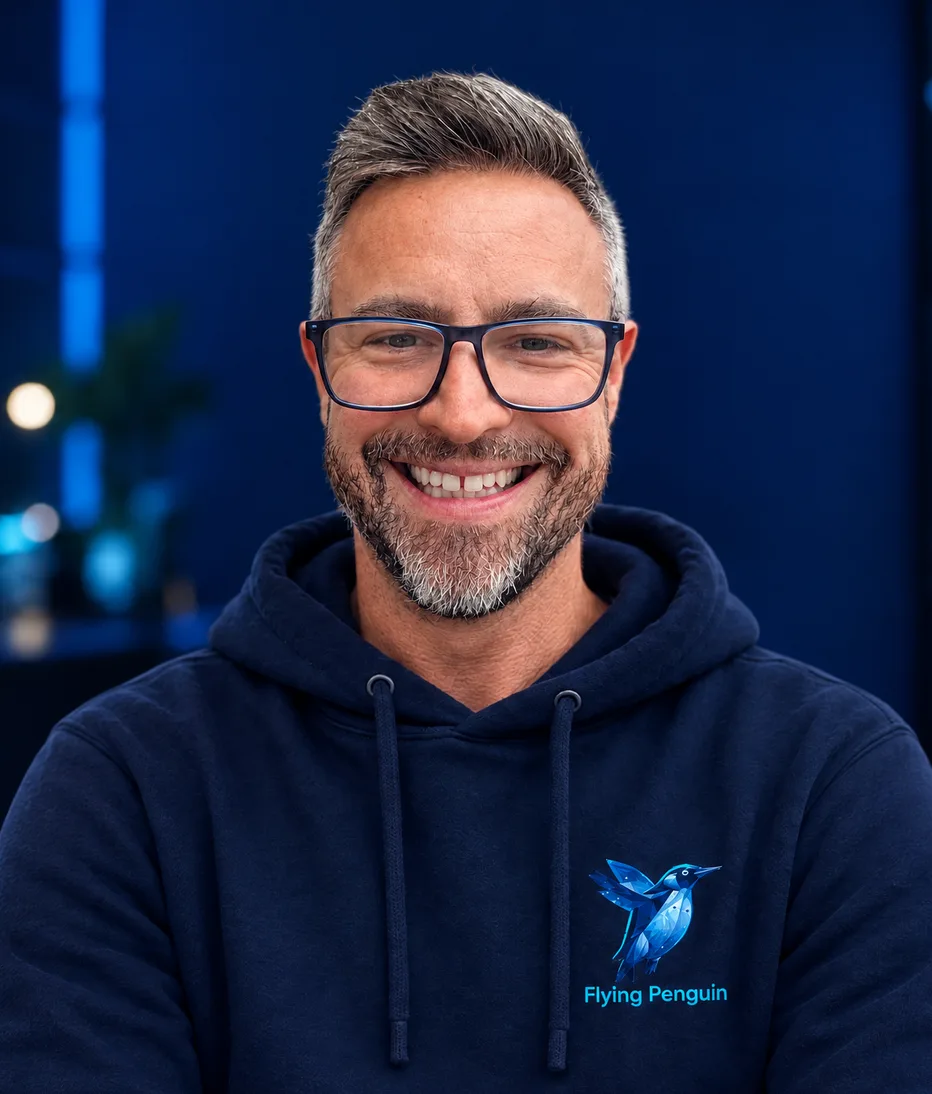
Portrait of Garreth Sleigh, founder of Flying Penguin
Garreth SleighFounder, Flying Penguin

Why I build this way

“I didn’t set out to build a digital agency. I spent 23 years trying to make real retail businesses work better, and learning what happens when the technology underneath them does not.”

Flying Penguin grew from that. Every website, app and AI phone receptionist we build is shaped by problems I have faced myself: unreliable developers, conflicting plugins, rising subscriptions, hosting limits and losing control of the systems a business depends on.

I learned what to ask, what to own and what to avoid. That is the standard behind our promises.

  • AskWho builds it, where the code lives and who controls the accounts.
  • OwnThe domain, the hosting, the data and the logins stay in your name.
  • AvoidUnreliable developers, conflicting plugins, rising subscriptions and hosting limits.
2003 to 2026 · The Flying Penguin journey

How we got here.

Twenty-three years of running retail businesses, commissioning technology, hitting problems and learning how to build better.

  1. The first businessThe bedroom

    It started in a bedroom.

    Garreth started his first retail business from a bedroom in 2003. There was no digital department, technical team or investment behind it. There was a product, a customer to serve and the need to make an online business work with whatever tools were available.

    That meant learning every part of the job while doing it: finding products, answering customers, taking payments, packing orders and trying to build a website people could actually find and trust. The technology was never separate from the business. It quickly became the backbone of it.

  2. Learning by commissioningThe first websites

    Buying a website did not mean owning the outcome.

    Over the years we worked with website designers, WordPress developers, plugin specialists and agencies offering bespoke builds. Some work helped us move forward. Other projects arrived late, solved only part of the problem or left us with a system nobody else could safely change.

    When something broke, the business still had to trade. We learned to ask what was being built, where the code lived, who controlled the accounts and whether another capable person could take over. A website is too important to become a mystery that only one developer understands.

  3. Marketing without the smokeSEO promises

    We paid to get found, then learned what being found really takes.

    We dealt with digital marketing companies, SEO retainers and agencies promising to move us up Google. Reports arrived full of activity, but activity was not always the same as useful progress. Rankings, traffic and enquiries only matter when they connect to the right products, useful information and a website that turns interest into action.

    That experience taught us to look beyond a monthly report. Good search work starts with how customers describe their problem, builds pages that answer it properly and measures what happens next. Marketing cannot rescue a confusing website, and a beautiful website cannot help if nobody can find it.

  4. The hidden infrastructureHosting and domains

    The parts nobody sees can stop the whole business.

    We moved through hosting companies, domain providers and different server arrangements while traffic and product catalogues grew. We saw what happens when a site outgrows its package, when support is passed between providers and when the person who registered a domain is no longer available.

    So we learned the unglamorous essentials: where a domain is registered, who owns it, how DNS is controlled, what a server can handle, where backups live and how a site is recovered. Speed, resilience and ownership are not technical extras. For a retailer, they protect the front door of the business.

  5. The WordPress yearsPlugins and conflicts

    Every useful plugin added another dependency.

    WordPress opened doors, but it also created a familiar cycle. One plugin fixed a problem, another added a feature, an update introduced a conflict and suddenly checkout, search or the layout behaved differently. When several companies were responsible for different pieces, nobody had the whole picture.

    We learned to test changes, understand what each plugin was doing and reduce the number of moving parts. Where an off-the-shelf product created more friction than value, we began designing tools around the actual workflow instead. The lesson was simple: software should make the business easier to run, not create another business to manage.

  6. The cost of convenienceSubscription overload

    A small monthly fee, multiplied across the business.

    For years the apparent answer to every digital problem was another subscription. Hosting, forms, search, email, reviews, reporting, security, automation and support all came with separate logins and monthly charges. Individually they looked manageable. Together they became expensive, fragmented and difficult to leave.

    We learned to judge a tool by the value it creates, the data it controls and the work required to replace it. Flying Penguin now looks for the smallest dependable stack that does the job well. Clients should understand what they are paying for, what can be removed and what they will still own if the relationship changes.

  7. Keeping controlOwnership and access

    Your digital assets should remain yours.

    We learned the risk of relying on one developer, one agency or one provider for everything. If the relationship ends, access disappears or a company changes direction, the business can be left without the keys to its own website, domain, data or customer systems.

    That shaped one of our strongest principles. Important accounts should be registered correctly, access should be documented and the business owner should retain control of the assets they paid for. A good partner makes themselves useful through the quality of their work and support, not by making it difficult for a client to leave.

  8. Building what we neededFrom fixing to building

    Eventually, solving the same problems became a capability.

    Each failure pushed us to understand more. We learned how websites are structured, how systems connect, how performance changes under real traffic and how a small technical decision affects the person packing an order or answering a customer. We stopped treating technology as something that could simply be handed over and forgotten.

    Then we began designing and developing more of what our own businesses needed: clearer websites, dependable hosting, focused plugins, connected admin tools and automation built around real work. We failed forward, carrying each lesson into the next build and removing the hurdles we had already met ourselves.

  9. Flying PenguinRetail became the brief

    An agency born behind the counter, not in a boardroom.

    Flying Penguin is the result of that 23-year education. It was not imagined as a university project or built around an agency sales model. It grew from retail businesses where the website had to sell, the phone had to be answered, customer information had to move and every monthly cost had to justify itself.

    That is why we start with the business rather than the technology. We understand the pressure of relying on systems you do not fully control, paying for products that do not quite fit and needing help in plain English. We build so other business owners can move forward without falling into every hole we found along the way.

    See what that experience now builds

The whole business
in the picture.

Choose a service for a quick look.

We start with the challenge, work through the options with you and build a prototype you can try before you commit.

Nottingham & Derby / UK-wide

Tell Garreth what is not working.

15 minutes with Garreth, the founder. Bring the messy version. Or see pricing and how it works first.